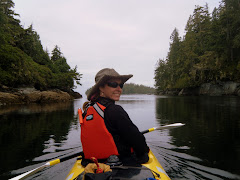
Living on the most eastern of the San Juan archipelago islands, Fidalgo island, the variety of trip & training paddle routes from here are endless. While strong currents do exist in nearly every channel surrounding our island shores, learning how to use these currents to travel in the back eddies, the mid-channel-river-like 'green tongue', along with harnessing the strength of the winds (with kayak sails), is what paddling the San Juans is all about to us... Efficiency. Speed. Using what Nature offers to help us achieve our paddling (distance travelling & racing speed) goals. Which sometimes mandates a combination of styles & skills from river and sea kayaking mixed in with occasional surfing and sailing. Adreline rushes. Personal Speed Records. Risk-taking. Innovation. ~Paddle the Islands and let Nature Inspire.~
Showing posts with label Orca whales. Show all posts

Saturday, March 10, 2012

Encounters with Orca Whales of the PNW


Encounters with Orca Whales of the Pacific Northwest from Island Paddlers on Vimeo.

Here at Island Paddlers a summer in the Pacific Northwest wouldn't be complete without spending some quality time escaping into the ruggedly remote environments of the San Juan and Broughton island archipelagos- ritualized annual expeditioning with our kayak and cameras.  Some years we'll paddle thousands of miles and see not one, while other years lucky timing on island shorelines provide the best viewing perches for exhilarating glimpses of glistening dorsals and bursting exhales. 


For us, nothing in Nature compares to time spent with our favorite sets of North Pacific Ocean resident Orca whales, the Canadian Northern Residents of the isles and channels in British Columbia's Johnstone Straits, and their 'cousins', the three pods of Southern Resident Orca whales of Washington States' San Juan islands.  *The only killer whales listed as an Endangered Species.  
Observing the different distinct behavior traits of these two whale families and the humans who interact with them in their own watery neighborhoods each years satisfies the cultural anthropologist within...  


Take a few minutes and escape with us into this wonderful world of whales- with enchanting wild Orca whale encounters caught on video, kayakers being played with by a pod of curious Northern Resident Orcas in Johnstone Straits and closely passing pods of Endangered Southern Residents along the shores of San Juan island.

*Look and Listen for surprise close ups, roll overs, a spy hop, splashes, squeaks & squeals!

Friday, February 26, 2010

Whales and people: Tilly is not to blame for this avoidable tragedy

The following article was originally published on Psychology Today.com 2/24/10

Marc Bekoff is a former Professor of Ecology and Evolutionary Biology at the University of Colorado, Boulder, and co-founder with Jane Goodall of Ethologists for the Ethical Treatment of Animals. He has won many awards for his scientific research including the Exemplar Award from the Animal Behavior Society and a Guggenheim Fellowship. Marc has written more than 200 articles, numerous books, and has edited three encyclopedias.
"Tilly, a wild-born killer whale (orca), killed his trainer at SeaWorld Amusement Park in Florida. Many people have asked me about this tragedy so here are a few comments. Details about this most unfortunate incident are available in major media around the world but the accounts vary. First, let me be clear that this is a tragedy for all the animal beings involved. Second, let me be clear that in my opinion this could have been easily avoided if Tilly had not been "on show" and had been allowed to live out the rest of his life in dignity. Animals can be unpredictable, including members of our own species, and captive animals are often highly stressed to begin with.

That Tilly had a history of attacking humans does not mean that he was any more likely to attack again, but this should have been taken into account in how he was housed. In a TV interview I saw this morning her former trainer in British Columbia said it was his understanding that when Tilly was sold to SeaWorld, he would not be used in shows. But, unfortunately, he was. While the details remain unclear, it is totally possible that Tilly was surprised or "freaked out" by something that happened and responded as he did because he was afraid of something unusual.

This would be especially so if the trainer had actually slipped into the tank (rather than her being grabbed) as this would have been unexpected by Tilly. Many animals will run away from something that surprises or stresses them but TIlly could not because he was in a cage and there was no where for him to go. One of my companion dogs once grabbed my ankle when i jumped out of bed because I heard a noise outside my bedroom window and when I yelled "It's me!" she let go. She was a typical love-dog but was scared and startled when I did something out of the ordinary.

While we may never know the details of what happened this tragedy could have been avoided if Tilly had been kept apart from people (and perhaps other orcas) and allowed to live out his life in dignity. Perhaps attempts could have been made to reintroduce him to the wild from which was taken. Whether or not his "controversial history" was a factor also remains unknown, but this should have been taken into account when he arrived in Florida.

Unfortunately, killer whales and other highly sentient beings are shipped here and there from one zoo or aquarium to another to be used in shows that generate a lot of money. We need to respect these beings for who they are and not put them on display as if they're some sort of commodity or object who live for our own entertainment, because they're not. Indeed, many whales possess
spindle cells that are important in processing various emotions and anyone who's been around orcas and other cetaceans know that they are extremely emotional beings. Some people argue that cetaceans may fulfill the criteria for being called "persons."

My heart goes out to the humans involved in this tragedy and also to Tilly. Let's take all measures to make these sorts of encounters become things of the past by keeping whales and people apart.
Let me add that the video,
Luna is a must see for it shows how social orcas are and how friendly they can be. They need friends just like our companion animals.
It also is the case the "friendly"
wild animals will attack humans who they know well. Let's remember that many of these animals still have "wild genes" and can be unpredictable and can easily be startled. Furthermore, we really don't know what is lurking in their heads (and hearts) so we must be careful and not assume that they always will be friendly or predictable. In many ways these are accidents/tragedies waiting to happen.

*I just learned that Tilly has produced 13 babies for SeaWorld who have not been on display and will not be "destroyed."


http://www.psychologytoday.com/blog/animal-emotions/201002/whales-and-people-tilly-is-not-blame-avoidable-tragedy

Tuesday, October 6, 2009

Endangered Southern Resident Orcas

Do your part to protect these amazing yet Endangered Species...the Southern Residents of the Salish Sea... these three families, or pods, of friendly Orca whales reside seasonally in our San Juan archipelago & BC island waters ...


They are sick. They need our help.

"Killer whales from the Salish Sea are some of the most contaminated marine mammals in the world and toxin loads are considered a factor in causing the decline of the southern resident population. Disease too is a major threat to the long term health of killer whale populations... http://www.seadocsociety.org/ "

What can you do?...


Fix car oil leaks. Recycle. Don't buy farmed fish. Reduce outdoor chemical usage on lawns and gardens= GO ORGANIC!!....Shop for Nature-friendly household cleaning products and alternatives... Educate yourself & your kids about these beautiful black & white beasts with help from the Orca Network and Center for Whale Research...Take a family trip on the ferry out to Friday Harbor and visit the Whale Museum... Abide by Whale wise guidelines when in proximity of the whales on the water....Donate some time and/or money to support a local non profit whose work benefits these magnificent marine mammals. Plus, plan to paddle in next years Orca Challenge Fundraising Kayak race ...and start making a difference, TODAY!!

Friday, September 25, 2009

NOAA's first public meeting held in Anacortes

At least 150 people showed up to the 1st round of 3 public meetings held Sept. 24th in Anacortes to listen and make comments on NOAA's proposed federal regulations, aimed at further protecting the Endangered Southern Resident Orca whales. A long line extended out the door from the larger than expected turnout.
The soft voices of the two NOAA women presenters were made even softer by their lack of microphone and bad acoustics in the large warehouse. The crowd soon turned hostile & antagonistically against these NOAA moderators, as it became pretty immediately obvious that the majority of folks in this disgruntled audience of mostly sport fishermen, whale-watch boat & kayak tour company owners did not support either the planned schedule in the agenda for the Q & A part of the evening nor especially did they take kindly to the proposed increased 200 yard distance regulations & establishment of a 'No Go Zone' along the west side of San Juan island...(*Not surprising since the whale watch industry alone is estimated to bring in over $7 million year annually to Skagit County.)
 While commercial kayak tour groups such as the above photo shows also currently launch daily en mass during summer months directly into the Southern Resident Orca whales favorite place in the San Juan island archipelago, the west side of San Juan island. Under NOAA's new proposed guidelines a 1/2 mile "No Go Zone" would prohibit these business owners from profiting while continuing to disturb an Endangered Species in their critical habitat...Needless to say these tour business owners are not embracing this protective idea.
Under NOAA's new proposed regulations, vessels such as these commercial whale-watch tour boats could be fined for intentionally positioning in the path of the oncoming Endangered Orca whales if passed. (*The two whale-watch boats I've worked on in the past two years, one Anacortes and one Bellingham-based, did this regularly.)
While this other locally based whale-watch tour boat often spend hours a day closely following the whales and whose captain is leading a strong fight against NOAA. Many at the meeting seemed to be overlooking that under the new proposed NOAA regulations there's still the whole rest of the ocean to view the Orcas. For example, close up viewings from a kayak as seen in the above photo, would still be possible here at Iceberg Point on Lopez island, just a few miles from the end of the proposed 'No-Go-Zone' at Cattle Pass on San Juan island.
We observed one locally based whale-watch boat closely follow the pods for hours while the above private power boater  blatantly and repeatedly blocked the path of Southern Resident Orcas as they travelled slowly down Rosario Strait one summer morning...
You betcha 'guaranteed whale sightings' that the same commercial boat owner was at the meeting, expressing his opposition to the proposed increased distance regulations- presumably driven by the fear of decreased profit $$ to be made by further protecting the Endangered Species.
A short video clip of the Sept. 24th, NOAA public meeting.

We met several friends at the meeting, all of us you could say were 'on the whales side' and in support of NOAA's new proposed regulations. One word adjectives came out of each of us throughout the evening as we disappointingly described the unruly crowd at the Anacortes public meeting:
Fear. Anger. Selfishness. Rude.
Not exactly the compassionate characteristics of people who have the best interest of the future of our Endangered Southern Resident Orca whales in mind. But then again, these are the same folks who have depleted the Orcas favorite food, the Chinook salmon to an Endangered Species listing also, through decades of overfishing. Reduced food supply, environmental & noise pollution are the biggest threats to the Southern Resident Orcas.
**Many of these Anacortes-based commercial whale-watch & fishing boats also still continue to pollute the Salish Sea waters through the unnecessary practice of dumping their onboard sewage into the very same waters which the Orcas feed, breed and travel...when they could be pumping out FOR FREE at the marinas upon return.
(Want to see for yourself? All you have to do is spend some time watching the sewage pump-out dock inside Cap Sante Marina here in Anacortes and you'll quickly notice that not many commercial boats based are stopping to pump out at it.)
*Unfortunately, the Anacortes Chamber of Commerce has also chosen not to support NOAA but rather to oppose this agency's protective proposal. And so it goes here with small town politics, presumably because whale-watch captains are also Chamber board members, and the big money this corrupt industry brings to our small town seems more important that protecting our marine mammals and environment.

Sunday, August 9, 2009

Whale watchers


From the whales persperctive....

Tuesday, December 16, 2008

~ San Juan ORCA Whales ~


~In the waters of the Straits of San Juan de Fuca, with the Olympic Mountains on the Olympic Peninsula as the backdrop, this male Orca breached a few times, as he playfully made his way by us and through a bed of bull kelp...

*Want to stay connected to the Southern Resident Orca whales? (We sure do!) When you can't be on the water with the whales, get reports from those who are!...

~Go to http://www.orcanetwork.org/ and click on "Join our Sightings List" to receive regular email updates of local whale sightings mostly around the Puget Sound and occasionally from different locations along the West Coast- including residents and transient Orcas, Grays, Humpbacks and Minkes...

~You can also LISTEN to real Orcas in the wild- live via the internet- http://www.orcasound.net/ whenever they travel past underwater hydrophones strategically placed around the Salish Sea...